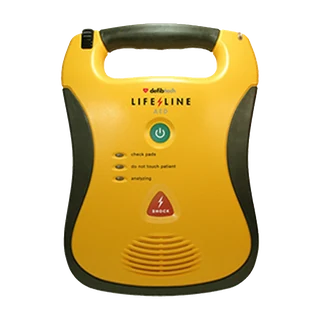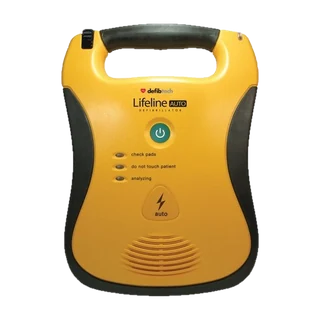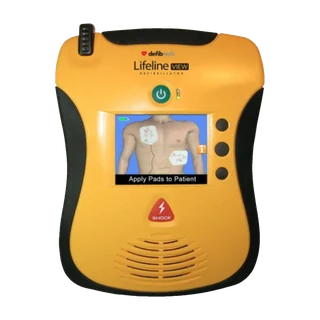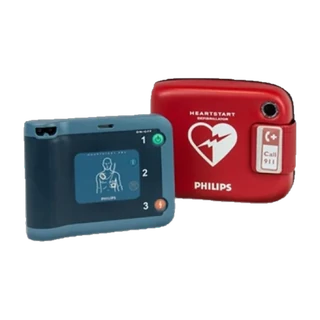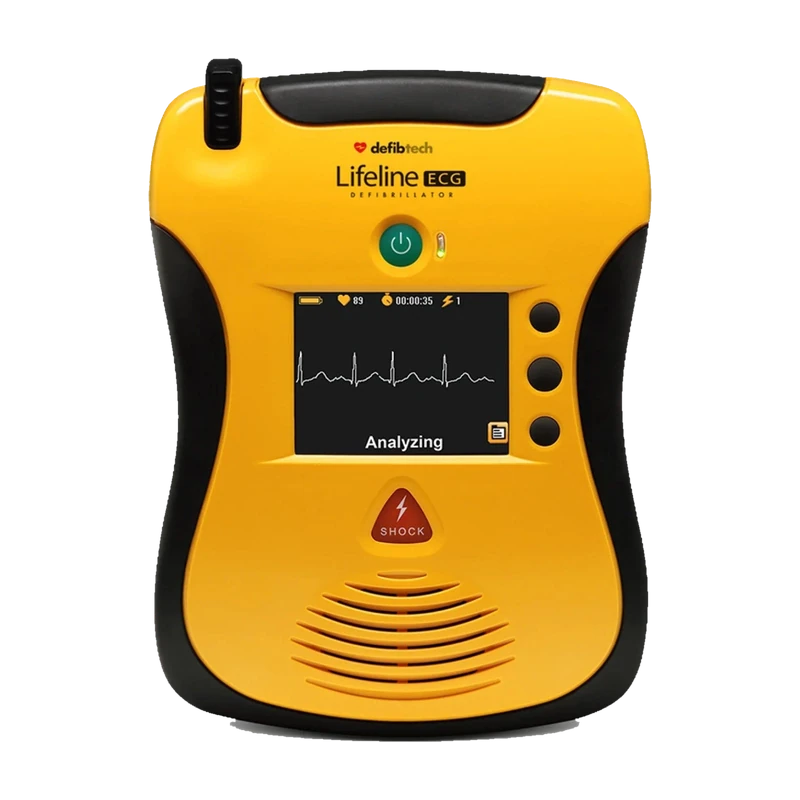
Is this your AED?
Like the Lifeline VIEW, with “Lifeline ECG” on the front. It can show a heart trace. The model name is printed on the front of the unit and on the label at the back.
1. Is it ready? Check the readiness light
Every AED tests itself and shows the result on a readiness indicator. On the Lifeline ECG it is the small light just right of the On/Off button.
- Ready: It flashes green. Watch for 10 seconds.
- Not ready: Red, or no green flash in 10 seconds, means it needs attention.
See what the light means on other models in our status light guide.
2. Find the serial number
With the AED switched off, press the middle button beside the screen. The status screen shows the serial number and the battery and pads dates, which on the unit itself face inwards. Read the “AED S/N” line, not “Battery S/N”. There is also an “SN” label at the top of the back (not the “REF” label beside it).
How old is your Lifeline ECG?
Defibtech serial numbers don’t contain a date, so look for a date of manufacture on the label instead.
Age matters: many AED owners plan to replace a unit at around ten years, and an older unit may no longer be supported by its maker. More in how old is my AED.
3. Check the pads expiry date
On the same status screen: the “Pads status” line shows the expiry date.
Replace the pads if the date has passed, after any use (they are single-use), or if the package is open or damaged. Expired pads can dry out and may not stick or conduct properly. More in AED pads expiry.
4. Check the battery date
On the same status screen: the “Battery status” line shows the expiry date.
More in AED battery expiry.
5. Make sure the battery is fitted
Turn the AED over: the battery at the top of the back should be pushed fully in and flush.
6. Make sure the pads are connected
The pads connector plugs into a socket at the top-left corner, by the handle.
Child pads or key
Keep a spare child/infant pads package (DDP-2002) if children could be present.
The cabinet, rescue kit and emergency sign
- Cabinet or case: easy to reach, not locked or blocked, and the alarm working if it has one.
- Rescue kit: gloves, a razor, scissors and a CPR face mask, sealed and with the AED.
- Emergency contacts sticker: on the AED or its cabinet, with your local emergency number.
If something fails
Many faults take seconds to fix: push the battery fully home, plug the pads back in, close the lid, then check the readiness light again. An expired battery or pads can’t be fixed on the spot and need replacing. The free inspection’s report lists exactly what failed, and you can ask for a quote for the right pads or battery for your Lifeline ECG from the result screen.